

A physician-led technology optimization initiative at Frontier Dermatology moved the organization toward proactive, strategic technology planning driven by the practice itself, rather than decisions led by an outside vendor. This shift was central to Frontier Dermatology’s decision to partner with HealthSpaces: rather than ceding the keys to their technology and infrastructure to a vendor, Frontier Dermatology wanted a partner who understood their strategy and let them retain ownership and control of their own systems. Through a governance model anchored in peer-to-peer physician leadership, clinical leaders aligned more effectively around technology and budget decisions. This approach reduced unplanned financial spend and established long-term operational stability. Practice Overview Company Name: Frontier Dermatology Locations: ~40 locations across the Pacific Northwest (Oregon & Washington) Practice Size: 55+ physicians, 30+ PAs, 35+ NPs, residents, and aestheticians Practice Type: Dermatology What We Solved For many physician-owned practices, technology costs often feel like a combination of overly complex “black box” solutions that intermittently require a seemingly “black hole” level of unplanned CapEx and OpEx spend. Frontier Dermatology did not need incremental process refinement. The challenge was to transition from a fragmented, vendor-driven environment into something predictable, before pursuing improvement that was financially realistic for a mid-enterprise practice. Before partnering with HealthSpaces, Frontier Dermatology experienced frequent unplanned financial spending driven by vendor-initiated infrastructure refreshes, architecture decisions, end-of-life timelines that weren’t communicated in advance, and time-sensitive system updates – all of which disrupted the practice’s financial planning. Beyond the numbers, there was a cultural gap. Technology was often viewed as an administrative burden rather than a clinical tool. Technology felt like something done to the practice rather than something delivering value for the practice. Without a roadmap aligned to the business’s goals, technology investments lacked the support needed to connect back to Frontier Dermatology’s strategy, while legacy tools frequently created operational friction, preventing staff from focusing fully on patient care. Frontier Dermatology needed a way to proactively prepare for technology investments while ensuring decisions were vetted by the people delivering care and supporting clinical operations. Key Results 1. From Multiple Strategies To One Aligned Strategy Frontier Dermatology implemented a three-year technology roadmap and budget that gave executive leadership and clinical stakeholders clear visibility into future technology needs, costs, and the support required to achieve their goals. This shift replaced last-minute funding requests with a disciplined, transparent planning model aligned to clinical and operational priorities. “Before, our IT vendor didn’t have a roadmap or budget that connected our technology spend to our business goals. Now, working in partnership with HealthSpaces to support our business objectives, our executive team can look three years out, understand what we’re investing in and why, and make decisions from a position of strength instead of opting directly for whatever a vendor is telling us we need next.” – Bill Frerichs, CEO, Frontier Dermatology 2. Clinical Alignment Through Shared Decision-Making To ensure technology decisions supported clinical operations rather than disrupting them, Frontier Dermatology reinforced a peer-driven decision-making approach grounded in physician leadership and operational stakeholders. While a physician-led Technology Steering Committee provided formal structure, alignment extended well beyond a single forum. Technology priorities were shaped through clinical peer input from physicians helping distinguish between refinement that added real clinical value and complexity that is not economically efficient at mid-enterprise scale. By centering decisions around real clinical experience, Frontier Dermatology built trust, improved alignment, and enabled smoother execution across the organization. “When technology decisions come from physician peers who are actually in the clinic, you know they support what our patients need, what our team and providers need, and what the business needs. When those three are aligned, you get better outcomes. That’s not a small thing at our scale.” – Bill Frerichs, CEO, Frontier Dermatology Part of the value of this roadmap-driven approach was that it started with the actual problems Frontier Dermatology needed to solve, rather than the many solutions vendors often bring looking for a problem to attach to. By identifying real clinical and operational needs first, and only then evaluating which technology could address them, Frontier Dermatology ensured every investment made outcomes measurably better, not just different. When new initiatives were introduced, recommendations were reviewed through this peer-informed framework before vendor and product selection and broader rollout. Because guidance came from respected physician leaders and administrative stakeholders rather than vendor-driven solutions, adoption was smoother and technology stayed aligned with the needs of patients, providers, and the business — driving better outcomes across the organization. This approach preserved physician autonomy as the organization scaled, kept technology aligned with clinical standards, and supported a practical, evolving roadmap that could flex and remain relevant over time. 3. Reinvesting for Practice Longevity and Scalable Growth Frontier Dermatology’s technology transformation generated more than $1.2M in measurable economic impact by converting inefficient technology spend into sustainable cost savings and a scalable operating model. Technology shifted from a standalone expense into a repeatable operating advantage, aligned with the business’s broader goals and directly supporting integration, growth, and financial discipline. Targeted reinvestment strengthened foundational security and infrastructure, including $600K savings in network standardization and upgrades to deliver consistent performance and security across sites, and $195K savings in workstation upgrades, projected to reduce security issues and resolution time by 33%. HealthSpaces introduced different architecture options that are far more appropriate for a mid-enterprise practice, plus helped Frontier Dermatology implement more streamlined and collaborative support models, which better serve both clinical and business office operations. To sustain these gains, Frontier Dermatology established new operating rhythms and a regular cadence of communication and updates to clinic staff and leadership. This consistent visibility enabled earlier issue detection, tighter operational control, lower costs, and more confident execution of growth initiatives. – Bill Frerichs, CEO, Frontier Dermatology Conclusion: Reducing Unplanned Financial Spend Through Physician-Led Alignment By anchoring technology decisions in a long-term roadmap aligned with Frontier Dermatology’s business goals, the practice significantly reduced the unplanned financial spend that vendor-driven decisions had historically imposed on operations. Clear budgeting and long-range planning gave leadership confidence in future expenditures
Security as a Foundation, Not an Afterthought: Inside OrthoNY’s IT Security Transformation
How OrthoNY is scaling IT security alongside rapid practice growth. Company Name: OrthoNY Location: Albany, NY and surrounding region Practice Size: 11 clinical locations, 3 surgery centers Practice Type: Multi-Location Orthopedics What We Solved Fast-growing specialty practices face a common challenge: the technology and security infrastructure that worked at one scale doesn’t automatically keep pace as the organization expands. For a group the size of OrthoNY: 11 locations, three surgery centers, hundreds of users across clinical and administrative functions the leadership team recognized they needed a strategic partner, not just IT support. OrthoNY engaged HealthSpaces to build a formal security program grounded in federal healthcare standards, bring full visibility to technology spend across the organization, rationalize vendor contracts, and establish the strategic layer that could keep pace with where the practice is headed. Key Results OrthoNY’s internal IT team, led by Director of Information Technology Danielle Shults, had built a strong operational foundation. As the practice continued to grow, leadership made the proactive decision to bring in a strategic partner to complement the internal team – adding the security architecture, vendor management, and technology planning layer that would let OrthoNY scale with confidence. “We had the documentation and many of the tools. What we didn’t have was an overarching program. We were doing everything we could to keep up, but there was no framework underneath it – just a small team carrying more than was sustainable.” – Danielle Shults, Senior Director of Information Technology, OrthoNY Stakeholder interviews HealthSpaces conducted across clinical and administrative departments reflected the same thing leadership already knew: staff had deep confidence in Danielle’s team. The opportunity was in adding a strategic layer and advisory partnership – one focused on architecture, vendor accountability, and long-term planning rather than day-to-day execution. A security event that occurred before HealthSpaces came on board reinforced the urgency. Rather than treating it as an isolated incident, OrthoNY’s leadership chose to treat it as a signal – and invested in building the kind of security program that would position the practice for whatever comes next. What a Real Security Program Looks Like There’s a meaningful difference between being compliant and being secure. Most practices have documentation. Fewer have a functioning program underneath it – one where access is controlled consistently, vendors have been vetted, and leadership can actually see the full picture. The centerpiece was a formal security program built on the NIST Cybersecurity Framework, the federal standard for how healthcare organizations should structure security addressing the full range of threats healthcare organizations face: phishing attacks, system vulnerabilities, unauthorized access, and operational disruptions. And often, the biggest threat isn’t external, it’s an employee clicking the wrong link or using weak credentials across systems. Every layer: access controls, physical security, network segmentation, incident response, and business continuity was built to actually function, not just to check a box. The most operationally significant piece was deploying an identity platform that controls how every staff member and provider logs in across every application and location. In a multi-site practice where people move between locations regularly, consistent access control isn’t just a security issue – it’s an operational one. “What HealthSpaces built wasn’t a product sale – it was an architecture. For the first time, every access decision had a rationale behind it, and we had the governance model to make sure it stayed that way.” – Danielle Shults, Senior Director of Information Technology, OrthoNY Beyond the security program itself, HealthSpaces reviewed OrthoNY’s existing vendor contracts and renegotiated where pricing didn’t reflect the market. The managed security contract came down ~$30K annually. The identity platform dropped from ~$120K to ~$80K per year. Policy development and a formal security risk assessment – work that would have cost ~$43K as outside projects – were completed within the engagement. None of this required downgrading the security posture. That’s what happens when your partner has no financial interest in what you buy. Seeing the Whole Picture Before building a roadmap, HealthSpaces conducted structured interviews with stakeholders across OrthoNY’s clinical and administrative departments – asking not just what technology was in place, but how it was actually being experienced by the people using it every day. What came back was useful and specific. Like most growing practices, technology decisions had been made in the moment – by department, by need, by whoever was in front of leadership that week. One finding stood out: the practice was spending approximately $14,000 per month on a single service that hadn’t been benchmarked against alternatives since it was originally signed. The interviews fed directly into a multi-year technology budget that gave leadership a complete picture of what was being spent – and why. For a practice of OrthoNY’s size, that kind of clarity changes how every decision gets made going forward. The Strategic Layer That Was Missing For a practice operating across 11 locations with a growing technology footprint, the problem was never a shortage of IT talent and skillset. It was the absence of a strategic layer – someone who could sit alongside leadership, help translate technology into business decisions, and own the execution without requiring the C-suite to become technology experts. That’s what the vCIO engagement delivers. HealthSpaces serves as OrthoNY’s strategic technology partner – building and maintaining the multi-year roadmap, owning vendor relationships, driving the budget process, and making sure technology decisions reflect the practice’s actual priorities rather than a vendor’s sales agenda. The budget work alone changed how leadership operates. For the first time, the C-suite has a complete, categorized view of what the practice spends on technology and why – across people, applications, infrastructure, and security – with a roadmap that sequences what comes next. Technology is no longer a cost center being managed in the background. It has a plan, and leadership owns it. Where OrthoNY Is Headed OrthoNY now has a security foundation that scales as the practice grows, with leadership plugged in strategically so technology is included in growth decisions rather than scrambling to catch up after them. “The formalized security
I Let Agentic AI Loose in Our Google Ads Account. Here’s What It Found.
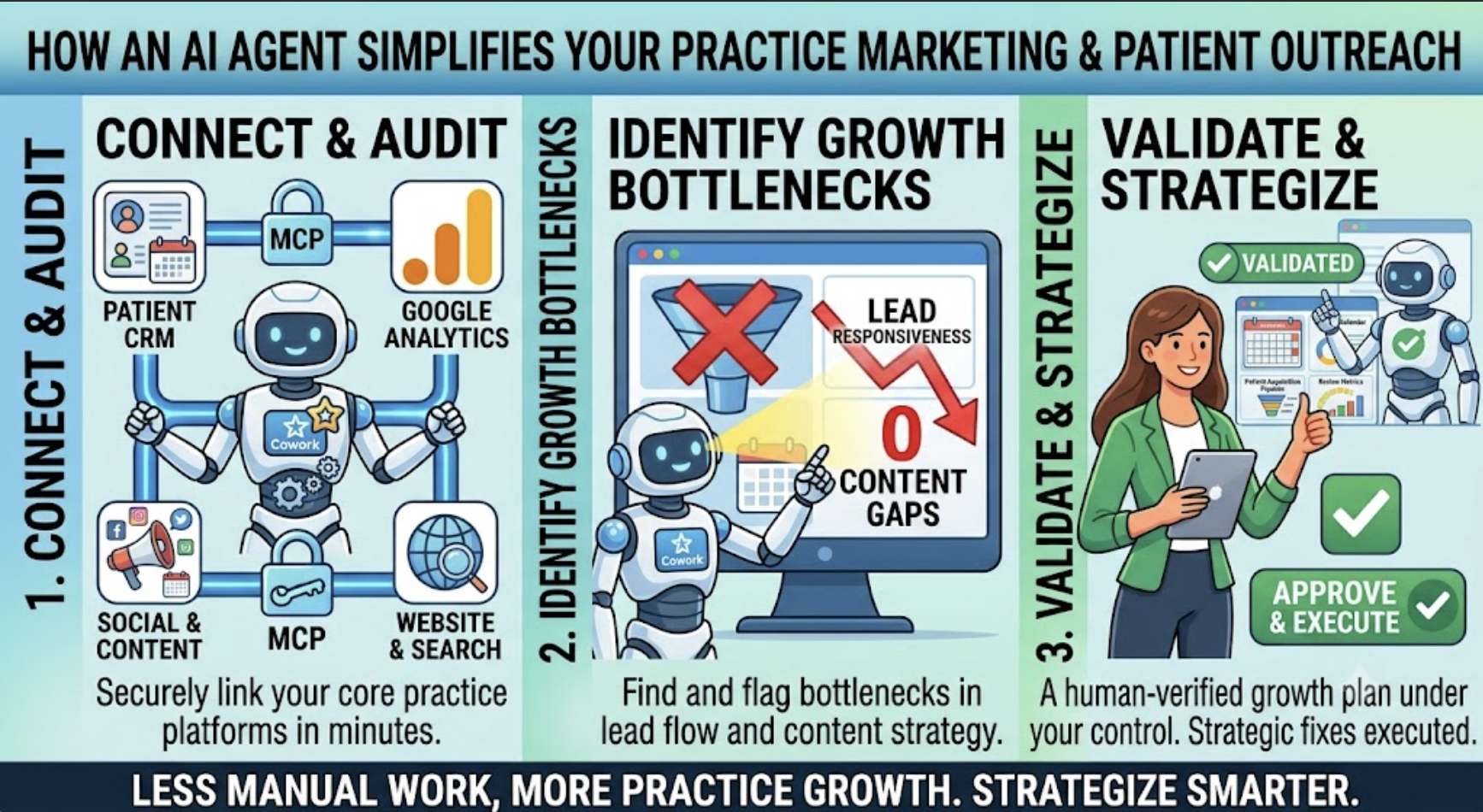
If you work in marketing for a physician-owned practice, whether that’s a dedicated team or one person wearing every hat, you’ve probably heard “AI” attached to every pitch that lands in your inbox. Most of it means a chatbot that writes captions or answers patient questions. That’s useful, but it’s not the part that’s about to change how marketing teams actually work. Most small teams are still doing the same manual work underneath all that AI hype: copying data from one app to another by hand, sorting through requests one at a time, and chasing follow-ups that should really happen on their own. And often, the “solution” is paying for another standalone AI tool for each individual task, on top of the tools you already have. The part that actually solves this is called agentic AI, and I want to walk you through what it looks like using my own accounts as the example. What “Agentic” Actually Means A regular AI tool answers a question. An agentic AI tool can look at your actual systems, find a problem, and then go fix it – with your approval, or on rules you set. The technology that makes this possible is something called MCP (Model Context Protocol). Think of MCP as a set of secure doors that let an AI assistant walk into specific tools, like Google Ads, Google Analytics, and Google Search Console, look around, and act, without you copying and pasting data back and forth all day. I connected Claude Cowork to our Google Ads, Google Analytics and Google Search Console accounts through MCP. Then I asked it to review performance and tell me what needed attention. What It Found In About Two Minutes Here’s the real read from our own account, not a hypothetical. I didn’t have to dig through three separate dashboards and cross-reference them by hand. The agent pulled campaign performance, cross-checked it against actual conversion behavior in GA4, and lined it up next to Google’s own recommendations, then summarized the one thing that mattered: some paid spend wasn’t earning its keep, while the free channel was carrying more than its share. Getting A Second Opinion, From A Second AI Before acting on any of it, I did something that’s easy to skip: I ran the same findings past a second, independent AI agent, Google Antigravity, and had it review Cowork’s read on the account. The point wasn’t to see which one was “smarter.” It was to check whether two different systems, looking at the same numbers, landed on the same conclusion. They agreed on the big issue (paid spend underperforming organic), which gave me more confidence to actually act on it rather than just trusting one tool’s word for it. This is worth doing anywhere an AI recommendation could cost money or touch something patient-facing. One agent catching a problem is useful. Two agents independently agreeing on it is a much better reason to act. Why This Matters, Whether Or Not You Have A Marketing Team Some physician-owned practices have a real marketing department; plenty of others have an office manager doing double duty, or an agency sending a monthly PDF nobody has time to fully read. Agentic AI is useful in both cases, just differently. For a marketing team, it removes the grunt work of pulling reports from three different platforms and reconciling them by hand, so the team’s time goes toward strategy instead of data-wrangling. It doesn’t just report numbers, it can also execute the fix – pause the underperforming campaign, add the negative keyword, adjust the bid strategy – once someone says go. For a practice without dedicated marketing staff, it’s the difference between never seeing this level of analysis and getting it on demand, without hiring for it. It also cuts down on tool sprawl. Instead of buying a separate AI subscription for your ads, another for your analytics, and another for your reviews, one assistant connected to the accounts you already have can do the job across all of them. Either way, it shouldn’t run unsupervised. I still review what it proposes before anything changes. But the review-to-action time went from “flag it for next week” to a few minutes. It’s Not Just Google Ads The same setup works anywhere there’s a connector between the AI and the tool. A few other places we’ve pointed it, or plan to: The Google Ads audit is just the clearest example because the before-and-after was so obvious. The pattern behind it, point the agent at your systems and ask it what it sees, applies well beyond paid search. What I’d Tell Another Marketing Team Starting Out The bigger shift here isn’t the technology itself, it’s what it frees people up to do. A marketing team gets its analysts back for strategy instead of report-pulling. A practice with no dedicated marketing hire gets a level of cross-platform analysis that used to require one. Either way, it’s the same agent, pointed at your systems.

Every Vendor Is Pitching You an AI Scribe. Here’s What to Ask Before You Say Yes.
The pitch is compelling. A physician walks into an exam room, has a natural conversation with a patient, and walks out with a completed clinical note. No typing, no dictating, no staying late to catch up on documentation. The AI handled it. That’s the promise. The question isn’t whether AI ambient documentation works in the right environment, it does. The question is whether your practice is set up to realize that benefit, or whether you’re about to spend $80,000 a year on a tool that creates as many problems as it solves. Every major health IT vendor is in this market now. Your EMR rep has a version. There are a dozen standalone tools with venture capital behind them and aggressive sales teams. And the physicians in your group are asking – or will be asking – why you haven’t deployed one yet. Here’s what your leadership team needs to work through before that decision gets made. The Integration Question You Need to Get Right Ask every vendor this directly: does your tool write into my EMR, or does the physician still copy and paste? You will be surprised how many cannot give a clean answer. There is a significant difference between an integration that writes structured, encounter-specific notes directly into the correct fields of your EMR – triggering downstream workflows like charge capture, referral orders, and care gap alerts – and a tool that drops a text summary into a free-text field for a physician to manually review and move over. The former saves 90 minutes a day. The latter adds a step. A tool that still requires copy-paste is not an EMR integration. It is a transcription service with a modern user interface. And at $40–80K per year, that distinction matters. Before any demo, get specific answers: Does the tool write to discrete data fields, or to a single unstructured note? Does it trigger existing EMR workflows, or does it sit outside them? What happens to documentation when the tool is offline – does your EMR workflow break, or does it degrade gracefully? And critically: what does the go-live process look like, and who owns configuration when your EMR is upgraded? True integration requires real coordination between the ambient vendor and your EMR’s implementation team. Practices that treat this as an IT checkbox – rather than a workflow redesign requiring clinical operations input – tend to discover the gaps six weeks after go-live, after physicians have already formed opinions about the tool. Also confirm your network can handle the load at peak capacity. A wireless assessment before pilot is not optional. The HIPAA Question That Will Come Up in Your Next Audit Every ambient AI scribe vendor will tell you they’re HIPAA compliant. That sentence means almost nothing without more context. What you need to know: Where is the audio processed? Is it on-device, on a private cloud instance, or on shared infrastructure? Who has access to the raw audio and the derived text? What are the data retention policies? Is patient consent captured in a way that satisfies both your state’s recording laws and your own HIPAA policies? And critically – does the vendor have a signed Business Associate Agreement with your practice, and have you actually read it? These are not hypothetical concerns. Several early ambient documentation deployments created compliance exposure because practices assumed HIPAA compliance was inherent to the vendor’s marketing claims rather than something that required their own review. A BAA that indemnifies the vendor but leaves you holding the bag on a breach is worse than no BAA at all. If your practice hasn’t updated its HIPAA policies to address AI tools that touch PHI, that gap is already creating exposure. The Physician Buy-In Problem Ambient documentation is one of the few healthcare AI applications that directly affects how physicians work moment-to-moment. That means adoption risk is personal, not just operational – and it carries real financial consequence. A tool your physicians won’t use is not a $0 line item. It’s whatever you paid for it, plus the implementation cost, plus the lost productivity during the transition. Some physicians will embrace it immediately. Others will be skeptical: accuracy concerns, patient perception of AI in the room, or legitimate uncertainty about whether the note output meets the standard of care. Both responses are rational. The mistake practices make is treating deployment as an IT rollout – here’s the tool, here’s the training, go use it – rather than a physician-led initiative. The vendors showing the best adoption numbers are the ones whose clients built structured accuracy review workflows before go-live, not after. Physicians need a clear process for flagging errors back to the vendor, and that process needs to be built into the deployment from day one. Organizations that skip this step see physician adoption collapse within 60 days. Genuine opt-out respect for physicians who aren’t ready is also not optional. Forced adoption in ambient documentation does not work. The Contract Terms Question Nobody Asks Until It’s Too Late The ambient scribe market is in the same position GPS devices were in 2007 and digital cameras were in 2004 – right before the technology became cheap, ubiquitous, and embedded in the devices everyone already carries. The standalone units that sold for $400 became a free app on a phone that cost less than the GPS unit did. Ambient scribe pricing will follow the same trajectory. As the underlying models commoditize and competition intensifies, per-provider per-year costs that seem reasonable today will look expensive against what the market will offer in 18 months. The practices that signed three-year contracts at current pricing will be paying a premium for capabilities their EMR vendor will eventually bundle in. This is not an argument to wait. It’s an argument to negotiate aggressively on contract length and exit terms. Push for 12-month agreements or annual opt-out clauses. Scrutinize auto-renewal language and price escalators. Understand what it costs to leave – data portability, integration teardown, and any minimum-spend provisions

Your Healthcare Staff Knows What’s Broken. Are You Asking Them?
There is a specific kind of organizational knowledge that rarely surfaces in a technology review. It belongs to the people closest to the work – front desk staff, medical assistants, billing coordinators – the ones who interact with your technology systems dozens of times a day and have long since figured out which parts work and which parts do not. It is not that these people are excluded from the conversation. Many of them are consulted by management. Some of them have raised issues before. The problem is that somewhere along the way, they stopped – because nothing changed when they did. And now, if you ask them how things are going, there is a good chance you will hear “fine.” It is the closest thing to ground truth your practice has about how your technology is actually performing. And it takes real effort to surface it. The Gap Between the Dashboard and the Floor Leadership tends to evaluate technology from a distance. Uptime reports. Invoice amounts. The absence of major incidents. If the systems are running and nobody has escalated a crisis, the assumption is that things are working. That assumption misses a lot. The systems may be running and still be generating significant friction for the people using them every day. A login process that adds three steps nobody designed intentionally. A platform that works fine on paper but is slow enough in practice that staff have developed informal workarounds to get through their day. A tool that was implemented eighteen months ago and adopted by about half the team, with the other half quietly doing things a different way. None of that shows up in an uptime report. None of it triggers an escalation. It just exists as background friction – absorbed by your staff, invisible to leadership, and quietly affecting productivity, morale, and patient experience. What Gets Lost When Nobody Asks The cost of not asking is harder to see than the cost of a system outage, but it is just as real. Workarounds become institutional. When staff develop informal ways around a technology problem – because the formal way is too slow, too unreliable, or too confusing – those workarounds become habit. They get passed on to new hires as “how we do it here.” The original problem never gets reported because everyone has adapted to it. By the time leadership becomes aware of it, the workaround is so embedded that fixing the underlying issue requires untangling months or years of informal process. The reason this happens is not always that nobody is listening. Often it is that staff raised the issue, got told it was “on the roadmap” or “coming in the next release,” and waited. Then raised it again. Then stopped raising it. Vendor promises have a way of training people out of complaining. The resignation that sets in is quiet – it does not look like frustration, it looks like acceptance. That is the signal that is hardest to see from a distance. Purchasing decisions get made without the right information. A practice considering a new platform, or evaluating whether to renew a current one, should know how the people using it every day actually feel about it. Do they find it intuitive or frustrating? Does it fit the actual workflow or force them to work around it? Is there a competing tool that staff have heard about or used elsewhere that might be a better fit? Vendors will tell you what they want to sell you. Your staff will tell you what you actually need. That intelligence exists in your organization. If nobody is asking for it, it does not make it into the technology decision. Good staff leave for reasons that could have been addressed. Technology friction is not the top reason people leave jobs, but it is a real one – particularly in healthcare, where administrative staff are already operating under significant pressure. When the tools do not work well and nobody in leadership seems aware of or interested in the problem, it communicates something about how much their daily experience is valued. That is a retention issue with a straightforward solution. What Asking Actually Looks Like This does not require a formal program or a technology committee. It requires a habit – and a willingness to dig past the first answer. The simplest version is a direct question asked on a regular basis – quarterly, at minimum – to the staff who interact most with your technology environment. Not “are there any IT issues?” which invites a binary answer. Something more specific: what is taking longer than it should? What have you figured out how to work around? If you could change one thing about the tools you use every day, what would it be? The important thing is not to take “everything is fine” at face value. Staff who have been told “it’s coming” enough times have learned not to bother. The first answer is often the polished one. The useful answer usually comes when you push a little further – when you ask about a specific workflow, a specific tool, a specific moment in their day that feels slower than it should. Those questions surface different information than a help desk ticket does. A ticket gets submitted when something breaks. These questions get at the friction that exists before anything formally breaks – the slow, the clunky, the confusing, the abandoned. That is where the useful signal lives. The other version is structured – a brief technology experience survey that goes to front desk, clinical support, and billing staff on a regular cadence. Not long. Not burdensome. Five questions, twice a year, with results that actually inform technology decisions. The value is not just in the answers. It is in the signal it sends that leadership is paying attention to the daily experience of the people doing the work. Closing the Loop Asking is only half of it. The other half is what happens with

The Carrier “5-Year Price Lock Guarantee” – Is It Really Working in Your Favor?
Managing technology for an independent specialty practice is anything but simple. Between EHRs, security, infrastructure, and a dozen vendor relationships, the last thing you need is more complexity. So when a carrier shows up with a clean proposal and a bold headline – 5-Year Price Lock Guarantee – it sounds like exactly the kind of clarity and stability you’ve been looking for. Predictable costs. One less thing to worry about. Done. But nothing in telecom is ever quite as simple as the headline makes it sound – especially in a market where the technology itself keeps improving and the price keeps dropping (for the carriere. Let’s say you sign a deal now for “Gig Fiber” (one of the newest offerings). Fast forward to 2030. A new option becomes available in your building – faster, more reliable, and priced well below what you’re paying today. You’d switch in a heartbeat. But you’re locked in. That’s the part that doesn’t make it into the pitch. The Market They’re Locking You Into Is Already Moving Here’s the problem with a 5-year price lock on broadband or dedicated internet circuits: you’re locking in a rate on a service that has been getting cheaper almost every year – and one where new products and service tiers are emerging almost as fast. The data is clear. Inflation-adjusted prices for the most popular broadband speed tiers have dropped nearly 60% since 2015. The real price per megabit has fallen more than 80% in the same period – while speeds have more than doubled. This isn’t a blip. It’s the structural trend of how connectivity markets mature, and it’s been going on literally for decades. When a carrier offers to lock your rate for five years, they’re doing the math too. They know where prices are heading. A “guaranteed” rate that looks good today is increasingly likely to look expensive by year three – not because your bill went up, but because the market went down. New Products. Same Contract. When a new service tier rolls out in your area – faster, more capable, and often less expensive – a price-locked contract may prevent you from switching to it. Some carriers do allow upgrades mid-contract, but read that fine print carefully. The standard provision requires that any upgrade be at equal or greater monthly spend than your current commitment. In other words: you can move to the new product, but only if you pay at least as much as you’re paying now – regardless of what that product actually costs a new customer walking in the door. You’re not unlocking a better deal. You’re just spending the same amount on something newer, while the market rate for that same service sits well below what you’re locked into. You don’t have to add a location or grow your practice to get caught in this. You just have to still be under contract when something better becomes available. The Same Logic Applies to Your Phone System Circuits get the most attention here because they’re where the largest dollars are – but the same dynamic plays out on the voice side. Multi-year price lock agreements have become a standard part of business phone and hosted VoIP proposals across the industry, and the pitch is the same: lock in your rate, get budget certainty. The problem is the same too. Hosted voice and UCaaS pricing has been declining steadily as competition has increased and the technology has matured. Per-seat costs that were standard three years ago are being undercut regularly by newer platforms and more competitive providers. A practice that locked in a hosted phone system in 2022 is likely paying above-market rates today – not because their needs changed, but because the market moved and the contract didn’t allow them to follow it. The phone system space is also evolving rapidly in ways that go beyond price. AI-driven features, deeper EHR integrations, improved patient communication tools – capabilities that weren’t broadly available when many practices last signed are now table stakes for newer platforms. A price lock that keeps you on an older platform at a locked rate isn’t just a cost issue. It can become a capability gap over time. Who Benefits from the Lock? It’s worth asking: what problem is the price lock actually solving – and for whom? For years, carriers built their businesses around complicated, promotional pricing – free months, upfront discounts, tiered introductory rates that quietly expired. The result was a market full of confused customers who had lost track of what they were actually paying versus what they had originally signed. Price lock guarantees are, in large part, a solution to a problem carriers helped create. They’re offering you simplicity and stability in exchange for a long-term commitment – after spending years making the pricing environment complex enough that simplicity sounds like a gift. These programs are also customer retention tools at their core – designed to reduce the window in which a competitor can come in with a better offer. The lock solves the carrier’s churn problem. Whether it solves yours depends entirely on where prices and technology go over the next five years. What Budget Predictability Actually Requires The appeal of a locked rate is real. Practices need to forecast technology spend. Nobody wants to rebuild the telecom solution every year. But predictability doesn’t have to mean being locked out of a declining market. A well-managed circuit inventory – with contracts that are regularly reviewed, renegotiated, or replaced as better options emerge – gives you cost predictability and the flexibility to take advantage of the market as it moves. The goal isn’t locking in today’s price. It’s making sure the price you’re paying next year reflects what the market is actually worth. The Questions Worth Asking Before You Sign Whether you’re evaluating a new circuit or reviewing a renewal on an existing one, these questions will tell you a lot: Where HealthSpaces Fits In Telecom and circuit management is one of the

5 Ways Your MSP Keeps Your Physician Practice Trapped
You have thought about switching. Maybe not seriously – maybe just a passing thought after the third follow-up email about an invoice that still does not make sense, or after the renewal letter showed up with a 12% increase and no explanation, or after the outage that took six hours to resolve because your “dedicated” support team turned out to be a guy in another state who had never heard of your EMR. You thought about it. And then you thought about what switching would actually involve. The migration. The passwords. The contracts. The systems your current MSP set up that only they seem to understand. And the thought passed. That is not an accident. That is the product. Your MSP’s most valuable asset is not their engineering team or their security tools or their monitoring platform. It is your inability to leave. And the playbook they use to build that inability is remarkably consistent across the industry. Here are the five plays. 1. The Long-Term Contract With Teeth The most obvious play and somehow the one that still works. Your MSP locked you into a three-year agreement with an auto-renewal clause buried on page fourteen. The cancellation window is 90 days – but only during a specific 30-day period before the anniversary date. Miss that window and you are in for another year. You signed it because the per-user rate looked competitive at the time. What you did not calculate was the total cost of that commitment – not just in dollars, but in leverage. A vendor who knows you cannot leave for 36 months has no incentive to perform at the level they pitched during the sales process. The contract was not designed to protect you. It was designed to protect their recurring revenue. A month-to-month agreement feels risky to the vendor. That is precisely the point. If your technology partner needs a three-year contract to feel confident they can keep your business, ask yourself what that says about the quality of their service. 2. The Hostage Infrastructure This one is quieter and more effective than the contract play. Over time, your MSP has set up your systems in a way that only they can manage. The domain registrar is under their account. The SSL certificates are tied to their reseller portal. Your Microsoft 365 or Google Workspace tenant is provisioned through their CSP agreement. Your firewall is configured with their proprietary templates. Your backup solution runs on their infrastructure. None of this was presented as lock-in. It was presented as convenience. “We will handle all of that for you.” And they did. Now every piece of your infrastructure has a dependency on their account, their credentials, or their platform. Try to leave and the first question becomes: who actually owns what? The answer, in most cases, is more complicated than it should be. That complexity is not a byproduct of the setup. It is the architecture. If you asked your MSP today to provide a complete inventory of every account, license, credential, and configuration they manage on your behalf – along with documentation sufficient for another provider to assume management – how confident are you that they could produce it? How confident are you that they would? 3. The Knowledge Silo Your MSP has one engineer who knows your environment. Maybe two. They know where the workarounds are, which server has the legacy application that cannot be updated, and why the VPN drops every Thursday at 2 PM. None of this is documented. It lives in their heads. This is not negligence. It is strategy. An undocumented environment is an environment that cannot be transitioned. If every configuration, every exception, every workaround existed in a runbook that another provider could follow, switching would be a project. Without that documentation, switching is a crisis. The next time your MSP tells you they are “too busy” to update documentation, understand what they are actually too busy doing: building the moat. 4. The Escalating Renewal Year one, the price was competitive. Year two, there was a “modest adjustment” tied to cost of living. Year three, there was a new cybersecurity requirement that added a per-user surcharge. Year four, the compliance module became mandatory. Year five, the price is 40% higher than where you started and nobody in your organization can explain exactly why. Each individual increase was small enough to avoid a confrontation. That is the design. No single renewal triggers a vendor review. But compounded over five years, your practice is spending significantly more for what feels like the same service – or worse. When your CFO finally runs the numbers and asks whether it is time to look at alternatives, the conversation circles back to plays one through three. The contract. The infrastructure. The documentation. And the increase gets approved because the switching cost feels higher than the renewal cost. Your MSP knows this math better than you do. They built the model around it. 5. The Fear of Transition This is the play that ties the other four together. Even when the contract allows it, even when the infrastructure is sortable, even when the documentation exists – there is the fear. What if the new provider is worse? What if the migration breaks something? What if there is downtime during the transition? What about the EMR? These are legitimate concerns. But notice where they come from. In many cases, your current MSP is the one surfacing them. “Transitions are risky.” “You do not want to disrupt patient care.” “We have seen other practices try to switch and it did not go well.” The vendor who is failing you is also the one warning you about the danger of finding someone better. This is not a technical concern. It is a sales tactic. A competent technology partner can execute a transition without disrupting clinical operations. It is done routinely. The practices that are afraid to switch are not afraid because transitions are inherently dangerous. They are afraid

The Mid-Enterprise Gap: Why Fortune 100 Technology Doesn’t Fit Your Physician Group
You have been in the meeting for your physician group. The one where the MSP or the vendor or the consultant puts up a slide deck full of platforms you have never heard of, acronyms that do not map to anything in your clinical world, and a pricing page that makes your CFO’s eye twitch. Somewhere in the back of your mind, a question forms that you may not say out loud: Is any of this actually built for us? The answer, almost always, is no. And the reason is simple: the technology industry does not have a word for what you are. So it has never built anything specifically for you. We call it mid-enterprise. And understanding what that means is the first step toward stopping the bleeding. What Mid-Enterprise Actually Means Mid-enterprise is not a marketing term. It is a classification for a very specific kind of organization that the technology industry has systematically overlooked. A mid-enterprise physician group operates between roughly 100 and 1,350 total users – physicians, mid-levels, clinical staff, billing, front office, and C-suite combined. That translates to anywhere from 15 to 325 providers across multiple locations, often including ASCs, imaging centers, or urgent care operations under separate or shared ownership structures. Here is why the label matters: a mid-enterprise group has all the complexity of a large healthcare organization – an EMR, a practice management system, a phone platform, PACS, cybersecurity obligations, HIPAA compliance across potentially multiple tax IDs, payer contracts, and a vendor ecosystem that nobody on the leadership team has the bandwidth to fully inventory. But none of the infrastructure that large enterprises use to manage that complexity. There is no CIO with a staff of 40. There is no $20 million IT budget. There is no internal team of systems administrators maintaining the platforms that keep the practice running. You are too big for small-business tools and too small for the platforms the industry keeps trying to sell you. You are operating in a gap. That gap is where the real damage happens. The Large-Enterprise Bias in Everything You Are Being Sold When you go looking for answers – managed services, security platforms, strategic IT guidance – the market hands you solutions that were designed for someone else. The analyst firms – Gartner, Forrester – produce excellent research for large-enterprise healthcare (Gartner Healthcare Digital Transformation). The vendors in their Magic Quadrants and Waves are global firms with tens of thousands of employees serving Fortune 100 and Fortune 500 organizations. The platforms they evaluate assume a dedicated CIO office, a team of IT administrators, and an implementation runway measured in quarters, not weeks. Those platforms trickle down to your practice through your MSP or your consultants – not because they are the right fit, but because they are what the market has. “Scaled down” versions of enterprise tools that carry enterprise pricing, enterprise complexity, and enterprise assumptions about the resources you have available to manage them. Your practice has none of those resources. But the vendor sitting across the table from you is selling as though you do. They know you do not. They sell it anyway. What This Actually Looks Like at 7:45 on a Tuesday This is not an abstract industry problem. It plays out in rooms you sit in every week. Your CFO reviews the annual technology budget and sees costs climbing – but cannot connect the increase to any measurable improvement in stability, security, or clinical throughput. The numbers go up. The friction does not go down. When she asks the MSP to explain, the answer is more acronyms: SIEM, EDR, XDR, MDR. She does not have the technical background to evaluate whether those tools are necessary, redundant, or oversized for a mid-enterprise environment. And candidly, that is not a finance problem – it is a leadership vacuum the vendor is happy to fill. Your COO – who probably grew with the practice, who earned her seat through years of operational excellence in billing or clinical ops – is now expected to evaluate vendor pitches for platforms she has never used, negotiate contracts with terms she did not write, and field Bright Shiny Object ideas from physicians who saw a demo at AAOS and want to know why you are not using that new AI scribe yet. She is already managing staff turnover, payer renegotiations, compliance deadlines, and the daily reality of keeping a multi-location practice running. Technology strategy was never in her job description. But there is nobody else. So she absorbs it. Your physician leadership approved a set of technology priorities in the last board meeting. Two weeks later, half the physicians have forgotten those priorities because they are back on the factory floor seeing patients – which is exactly what they should be doing. The technology decisions that were supposed to be physician-driven default back to whatever the vendor recommends. And the vendor’s recommendation always seems to involve a bigger platform, a longer contract, and a line item that somehow grows every renewal cycle. Funny how that works. Meanwhile, you are paying $10,000 to $15,000 for a commercial HIPAA Security Risk Assessment tool when the HHS provides an adequate one for free. You are running a cybersecurity stack priced for 10,000 endpoints across your 200 workstations. You have an enterprise ticketing system that nobody on your clinical staff actually wants to use because it was designed to protect the vendor’s time, not your patients’ care. None of this happened because your leadership team made bad decisions. It happened because your vendors made profitable ones. “Scaled Down” Is Not “Built For” This is where the industry consistently gets it wrong, and where the damage compounds fastest. Taking an enterprise platform and offering a “mid-market edition” does not remove the complexity. It removes the support infrastructure that was designed to manage the complexity. What a mid-enterprise practice ends up with is a sophisticated system that nobody internally fully understands, supported by a vendor whose real attention

Is Your MSP Overcharging You? What Physician Leaders Should Watch For
For physician-owned practices, technology is the backbone of clinical flow, patient access, and overall operational stability. Yet many leadership teams quietly deal with MSP relationships that feel unclear, inconsistent, or overly expensive. Across many practices we work with, physician leaders and executives often share the same frustration about their current MSP or internal setup: “We’re paying for support, but our environment doesn’t feel supported.” If that reflects what you’ve been sensing in your organization, it’s more than a passing concern, it’s a sign worth examining closely. 1. You’re Paying Premium Rates, Yet Daily Friction Still Slows Down Your Practice When clinical teams still deal with outages, slow systems, or recurring disruptions, it becomes a leadership issue: lost productivity, frustrated providers, delayed patient care. Leadership red flag:Your MSP says everything is “handled,” but your staff’s experience suggests otherwise. What strong technology partners ensure: Leaders shouldn’t have to absorb operational friction as “normal.” 2. Costs Increase, But Your Technology Maturity Doesn’t Even without discussing ROI, leadership can sense imbalance: more money going out, but the environment feels the same. Questions leaders naturally ask: If the answer is no or unclear, something is misaligned. 3. The Contract Protects the MSP More Than Your Organization Lengthy terms, auto-renew clauses, or fees buried in the fine print often leave leadership feeling boxed in rather than supported. A mature partnership offers: You shouldn’t feel stuck just because the paper says so. 4. You’re Nickel-and-Dimed for Routine Needs Leadership teams often discover they’re paying extra for basics that should be included – from straightforward user support to essential security tools. Common signals of overcharging in healthcare settings: This creates unnecessary complexity and often, unnecessary spend. 5. Leadership Has Little Visibility Into What the MSP Is Actually Doing Executives don’t need technical detail, they need clarity. But many MSPs provide the opposite: silence until something breaks. Healthcare-focused MSPs should provide: If you can’t describe what your Managed Service Provider does each month, the relationship lacks transparency. 6. Your MSP Isn’t Keeping Pace With Your Organization’s Growth Most physician-owned practices evolve quickly with new providers, new sites, increased patient volume, and new clinical services. When your managed services provider doesn’t anticipate or support those shifts, the entire practice feels it. A key warning sign:You grow or change, but the support model stays static. This goes beyond a vendor relationship. When your MSP isn’t evolving with you, it becomes a strategic risk – creating unnecessary friction, hidden vulnerabilities, and avoidable costs across the organization. A Leadership Checkpoint for Your MSP Relationship Physicians and executives don’t expect perfection; they expect clarity, consistency, and partnership. If you’re paying for support but still dealing with unpredictability, unclear billing, or stagnant progress, it’s worth reevaluating the relationship.

Invest in Technology Clarity Not Clutter This Conference Season
Tired of sitting through conference demos that promise to fix everything while your real headaches back at the practice go untouched? Conference season brings the same scene every year: endless noise, crowded halls, and vendors competing for your attention promising solutions that will change your practice. Everywhere you turn, vendors are telling you their tool will fix your practice’s pain points. A new platform to make scheduling seamless. Another cybersecurity layer. A software upgrade that claims to solve billing once and for all. The temptation is real: sign the contract, bring the new solution home, and hope it changes everything. But here’s the truth that doesn’t get said enough: the solution to your clinic’s technology challenges isn’t another product. The Hidden Cost of “More” Physician practices don’t fail because they don’t have enough tools. They fail because the tools they do have aren’t aligned with each other or with the organization’s bigger picture. The result? Practices spend thousands, sometimes millions, on “solutions” that actually increase complexity. Instead of creating stability, new tools introduce more chaos. The Conference Trap The sessions are great, but the vendor floor often creates an illusion.Conferences are designed to get you excited. They showcase innovation, highlight trends, and push urgency. But too often, what you see on the floor isn’t what you’ll actually get in your practice. Behind the polished demos and buzzwords, the reality is usually messier: Conferences give you energy and ideas—but they can also leave you chasing shiny objects instead of solving the real pain points you walked in with. But what most practices truly need isn’t the newest thing, it’s clarity and alignment. Without that, here’s what happens: A Better Way to Approach Conference Season Instead of treating conferences as shopping trips, treat them as strategy sessions. Go in with intention, and ask questions like: Conferences can and should be valuable. But their true value is in sparking strategic conversations, not collecting vendor swag bags and contracts. Build Before You Buy Band-aid technology isn’t enough. Every practice needs a foundation built on stability and alignment, and you must optimize before you automate. That starts with establishing a clear roadmap that connects technology to both clinical and business goals. It also means building alignment across leadership, physicians, and staff ensuring everyone is moving in the same direction. From there, you create a secure, stable, and scalable foundation that can truly support growth. Only once that foundation is in place does it make sense to add new tools because at that point, your investments actually deliver the outcomes vendors promise on the conference floor. This Conference Season: Press Pause So before you sign on the dotted line after your next conference, pause. Ask yourself: The practices that thrive are not the ones with the most tools. They’re the ones with the clearest direction. This conference season, don’t just buy more things. Build something that lasts.

Case Study – One Platform, Fewer Headaches: How this Orthopedic Clinic Cut Costs and Complexity
The all-in-one platform simplified operations and improved collaboration compared to Office 365 for Orthopedic Clinic IT. Company Name: Orthopedic Health of Kansas City Location: Kansas City, MO Practice Size: 14 orthopedic surgeons and 20+ PAs Practice Type: Multi-Speciality Orthopaedic What We Solved Reduced licensing fees, simplified technology systems, improved collaboration, and strengthened infrastructure reliability by transitioning OHKC from Microsoft 365 to Google Workspace. Key Results When a series of ongoing issues culminated in a preventable outage that left one of Orthopedic Health of Kansas City’s (OHKC) offices offline for a day, coupled with unresponsive support, Dr. Christopher Wise, OHKC orthopedic trauma surgeon, decided it was time to find a new technology partner. As a trauma surgeon of OHKC, Dr. Wise—who leads the practice’s technology initiatives—chose HealthSpaces for its innovative model for both engineering and support. He preferred the Slack-based support to the standard, slow ticketing-based system, with its inherent disadvantages of handoffs and escalations. The fact that HealthSpaces provides a dedicated on-site resource also stood out. “With HealthSpaces there’s no ticketing system. Everyone else we looked at, they don’t have that model. There’s usually a centralized help desk. You have to call or go online and file a ticket.” – Dr. Christopher Wise, Orthopedic Trauma Surgeon, OHKC The hands-on, real-time support model that drew Dr. Wise to HealthSpaces soon proved invaluable. After partnering with HealthSpaces, OHKC had to decide how to meet the rising cost and complexity of their compliance, security, and storage requirements. OHKC Confronts a Costly Licensing Upgrade At the time HealthSpaces came on board, OHKC was using Microsoft 365. But the current setup couldn’t support the practice’s evolving needs. They needed to upgrade their license to meet HIPAA requirements, enable full auditing, and ensure data loss prevention. Additionally, to meet new cybersecurity insurance requirements with 365, they’d need a third-party Identity Provider (IdP). Bottom line: remaining with Microsoft would have meant spending tens of thousands more each year. That’s when HealthSpaces brought up the idea of switching to Google Workspace. How Shifting to Google Workspace Saved Tens of Thousands Rifaat Kouaider (Ro), a Partner at HealthSpaces, and OHKC’s Product Owner, explained that Google could meet OHKC’s needs at lower cost and complexity. Kouaider showed Dr. Wise how Google provides the encryption, backup capabilities, and IdP service OHKC needed all in one bundle. “Ro got me all the costs and I know all the finances for what we buy. So it’s pretty easy to put together a little pro forma and say, ‘All right, this is how much we’re going to have to spend on Microsoft to do this. And this is how much we’re going to spend on Google Workspace. What do we want to do?’” Dr. Wise said. Dr. Wise presented the numbers to his board, and the decision was made. He explained, “If it wasn’t a big cost savings, people probably would not want to do it. But, you know, when it becomes a five figure number a year—times a couple—that gets noticed.” What Google Workspace Delivered While cost savings and compliance drove the switch to Google, additional benefits reinforced the value of the move. Improved Collaboration Staff at OHKC now use Google Chat to communicate in real-time and asynchronously, rather than collaborating through scattered email threads. And since they now use Google’s shared file system, it’s much easier to avoid the confusion of having multiple versions of the same document. This approach also allows for greater security, via centralized control and backup. In short, OHKC’s staff works faster because they face fewer version control issues and less email clutter. Efficient Storage After the transition to Google, OHKC began phasing out aging on-prem hardware. HealthSpaces helped OHKC migrate legacy EMR and network drive data into a 900-terabyte Google Drive environment, which reduced reliance on old infrastructure. The new, cloud-based storage system doesn’t just provide vastly more storage space, but also allows for future growth. Unlike the old infrastructure, the storage on Google Drive can expand as OHKC grows. “[With Google] we got 900 terabytes of shared data. So we can offload some of our on-site previous shared network drives that are on old hardware that needs to be retired anyway.” – Dr. Christopher Wise, Orthopedic Trauma Surgeon, OHKC Human Resource (HR) Process Enhancements Even HR processes saw improvement. With support from HealthSpaces, the OHKC team rolled out a new Google Sites intranet to house onboarding materials, HR policies, and single sign-on access—all managed by OHKC’s newly hired HR lead. This saves additional costs because it does not need costly IT resources to maintain. A New Normal: Stability, Strategy, and Confidence With the switch to Google Workspace, OHKC simplified operations across the board. A single solution now covers compliance, auditing, and identity management. That foundation has translated into improvements in the stability and reliability of OHKC’s technological infrastructure. Staff and leadership alike have renewed confidence in their systems and in their technological partnership. “HealthSpaces is very approachable because there’s not just one person. It’s a whole team of people,” said Dr. Wise. “They’re very responsive to either preventative things or crises as they’re happening.” With a major transformation behind them, OHKC and HealthSpaces have turned their attention to the future. Together with HealthSpaces, OHKC is developing an ongoing technology roadmap to guide decisions around modernization, budgeting, and strategic priorities. Instead of reacting to problems as they arise, OHKC is now proactively shaping its technology environment.

The Essential Healthcare Technology Alignment Checklist

Case Study – From Firefighting to Future Ready: Inside Desert Orthopaedic Group’s Technology Transformation
Practice Overview Organization: Desert Orthopaedic Center Location: Las Vegas, Nevada Practice Size: 27 physicians plus medical and administrative staff Practice Type: Multi-Speciality Orthopaedic What We Solved Strengthening system infrastructure, network reliability, and cybersecurity to support a seamless EMR implementation and deliver peak clinical performance. Key Results Desert Orthopaedic Center (DOC), an orthopedic practice in Las Vegas, NV, has 27 physicians, and has served patients for 55 years. As CEO of DOC, Michael Pendleton has led the practice for the better part of 30 years. Over that time, Pendleton said, “We’ve seen more and more need to become a technology company more than a healthcare company.” But until recently, DOC struggled with outdated technology infrastructure. Security vulnerabilities were common, and the internal IT staff lacked sufficient expertise. The on-premise servers the company used to host its PACS and EMR systems were unreliable and costly to maintain. Frequent system failures disrupted patient care, frustrated physicians, and caused financial losses. “When the day went right without an issue, you were surprised because it was just so bad. And we didn’t know how bad it was until we pulled HealthSpaces in and they helped us kind of map it out and see what needed to be done.” — Michael Pendleton, CEO HealthSpaces Takes Over Technology Management After cycling through a few different iterations of in-house IT teams, Pendleton had had enough. So he decided to turn to an expert. What happened next was a steady, methodical march from constant performance issues to Pendleton saying, “Over the years, I think we’ve achieved state-of-the-art systems and it’s been a constant process to maintain that.” Here’s how DOC and HealthSpaces got there: Putting Out Fires, Setting the Foundation Once HealthSpaces stepped in, the priority was shifting DOC from its reactive stance to a proactive technology strategy. The following areas highlight what that shift looked like. 1. Infrastructure Overhaul HealthSpaces helped oversee DOC’s switch from a disorganized assembly of technologies that sometimes worked to a cloud-based infrastructure with high availability and scalability. “It’s been nice for our physicians to have some comfort that their systems are going to be working 99% of the time,” Pendleton said. But the infrastructure overhaul was not just about making things work. It was also key to setting the foundation for Desert Orthopedic’s transition to a cloud-based Electronic Medical Record (EMR), among other things. “We changed our PACS system and our group practice system at the same time [as the EMR]. So that was all a big change. [HealthSpaces] had gotten us to a point where we were ready to take that on.” 2. Cost Reduction & Optimization During the overhaul of DOC’s infrastructure, HealthSpaces worked with Pendleton and the clinical and business office staff to eliminate waste, something previous technology administrators had either not wanted to or could not take on. Far from paying someone to get up to speed, Pendleton said that thanks to processes they’ve been able to automate, he’s seen “hundreds of thousands of dollars of cost savings on the staffing side.” Simply put, HealthSpaces provided the leadership and vision that DOC needed to identify and confidently eliminate redundant software and streamline technological operations. 3. Proactive Technology Planning Before HealthSpaces came on board, DOC faced a challenge that is unfortunately very familiar to mid-enterprise practices. They relied on solutions designed for large enterprises, such as on-premises servers for their EMR and PACS systems. This made maintenance a nightmare. Still, Desert Orthopaedic made do with what they had because it was too big a task for their in-house staff to handle on their own. What finally spurred the switch to a cloud-based infrastructure was the confidence HealthSpaces provided Pendleton and his team in proactive planning. HealthSpaces helped establish a vision for the future and laid out the steps to get there. “With Jeff, [HealthSpaces Engineer and Co-Founder], I always felt confident that he could help me understand it in a way that made sense from a cost-benefit analysis.” Pendleton continued, “That’s the beauty of HealthSpaces. They’re going to tell us where we’re at, why we’re doing it this way, and these are the steps that we’re going to take.” Project Spotlight: HealthSpaces’ Role in EMR Selection & Preparation One of the biggest projects Desert Orthopedic undertook since HealthSpaces came on board was switching to a new, cloud-based EMR system. As DOC’s current system, Centricity, was being phased out, the practice needed a modern, scalable replacement. Rather than rushing into an implementation, HealthSpaces helped Desert Orthopaedic Group: After selecting Modernizing Medicine (ModMed), HealthSpaces ensured that technology infrastructure was fully optimized before implementation. As Pendleton explained, setting that foundation minimized disruptions and positioned the project for success. “HealthSpaces helped us with all of the nuts and bolts of the system requirements and making sure everything tied together and which other softwares would now be redundant and we could get rid of,” he said. A Foundation for Long-Term Success As CEO of Desert Orthopaedic Group, Pendleton always knew his company needed to become a technological leader. He just didn’t have the internal resources or expertise to do it. When he teamed up with HealthSpaces, that all changed. Now, technology is an asset rather than a liability. Pendleton summed it up, “With HealthSpaces every cent has been well spent and has gotten us to the point where we are today. And that peace of mind ultimately for me as an administrator is the most valuable. You can’t put a price on that.” Ready to Make Technology a Competitive Advantage? At HealthSpaces, we help physician-owned practices transform technology from a daily frustration into a strategic advantage. With our help, your systems run smoothly, your staff stays focused, and your organization is ready for what’s next.